
Home prices rose 41% from 2019 to 2024 while owner incomes rose 19%, a city housing study finds. Renters under $50,000 are short about 5,000 homes.
Home prices in Sandy Springs rose 41% from 2019 to 2024. Homeowners’ incomes rose 19% over the same years. That gap is the headline finding of the city’s updated Housing Needs Assessment, presented to the City Council on Oct. 6.
The study was prepared by the consulting firm HR&A Advisors and updates the city’s 2020 assessment. The presentation is in the agenda packet for the Oct. 6 work session, and the council’s discussion is in the summary minutes posted since.
The key numbers
From 2019 to 2024, the study found:
- jobs in the city grew 12%
- households grew 10%
- the population barely changed
- home prices rose 41%, against 19% income growth for homeowners
By 2024, the city was short about 5,000 rental homes for households earning under $50,000, the study said.
The study reads the flat population and rising household count as a sign that families are leaving while smaller households move in. Two-person households grew by about 3,100 and one-person households by about 2,000. Households of five fell by about 800.
The city added about 1,800 net new homes over five years, the minutes said. That was not enough to keep up with job growth. Council members cited an estimate that about 4% of people who work in Sandy Springs also live there.
Buying a first home
The study puts the price a typical renter could afford to pay for a home at about $335,000. It said renters can afford roughly half the cost of a typical home in the city.
About 30% of homes sold in 2024 and 2025 were at or below that price. Where those homes are depends heavily on zoning:
- almost 90% of the affordable sales were on lots smaller than 5,000 square feet
- 84% were in areas the city zones as Urban Neighborhood, which allows smaller lots
- of roughly 1,500 sales in Protected Neighborhood areas, 22 were affordable to first-time buyers
Older homes are the main way in. The study said relying on them is not sustainable, because redevelopment and rising values keep shrinking that supply. The minutes noted that a teardown replaced by a larger, pricier home counts as replacement housing, not a new home.
Renting
There were 4,500 more renter households in 2024 than in 2019. Most of the growth came from households earning more than $150,000. Renter households earning under $75,000 fell by about 5,000. The study said some of those households saw their incomes rise and some left the city.
About 45% of renter households, roughly 11,165, spend more than 30% of their income on housing, which the study counts as cost-burdened. The burden falls hardest on some groups:
| Renter households | Share cost-burdened | Number |
|---|---|---|
| Seniors | 74% | 1,564 |
| Single parents | 73% | 1,512 |
| Hispanic or Latino | 62% | 1,696 |
| Black | 50% | 4,618 |
| With children | 48% | 2,449 |
| All renters | 45% | 11,165 |
The study notes that senior figures run high because cost burden measures income, not savings, and that some households fall into more than one group.
Why so few apartments were built
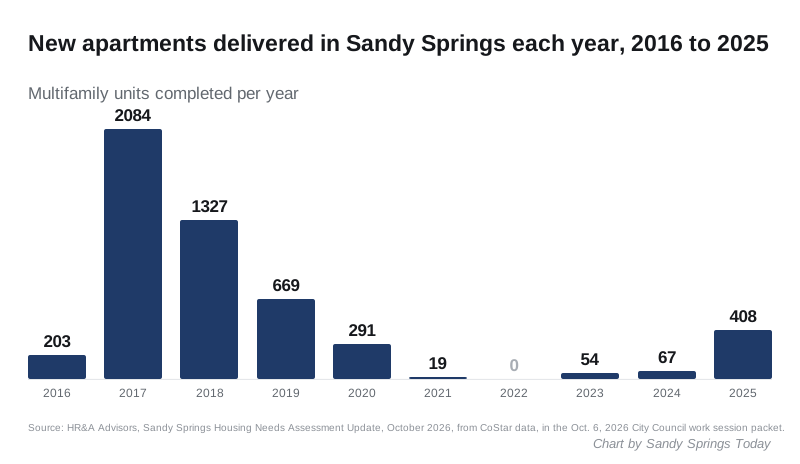
Apartment construction in Sandy Springs peaked at 2,084 units in 2017. Then it nearly stopped. In 2016 the city changed its building code in a way that, the study said, effectively banned wood-frame apartment buildings taller than three stories. The city removed that rule in late 2023.
Deliveries averaged about 110 units a year from 2021 to 2025, according to the study’s CoStar figures:
- 2021: 19
- 2022: 0
- 2023: 54
- 2024: 67
- 2025: 408
The study said construction has not fully recovered, because of lingering pandemic effects, a changed financing market and supply chain problems.
What the city might do
The assessment does not recommend specific actions, the minutes said. It will feed into housing policy in the city’s comprehensive plan, which is being rewritten now. The study lists three kinds of tools the city could consider:
- Land use: zoning that allows smaller, cheaper home types
- Subsidy: public money or public land to make affordable homes possible
- Preservation: keeping existing low-cost homes and helping renters avoid displacement
Council members raised traffic, neighborhood character and community concerns about apartments, the minutes said. Several said the city needs more homes people can buy. Aging shopping centers and commercial sites were named as possible places for new housing.
What it means for you
- Nothing changes yet. No zoning or housing rules were proposed.
- The next public workshop on the comprehensive plan and parks master plan runs 6 to 8 p.m. Thursday, Oct. 29, at the Conference Center at City Springs, 1 Galambos Way, the city said in its announcement. That is where housing policy will be shaped.
- Our home prices page tracks values month by month, and our building permits and zoning guide explains how rezonings work in the city.
Frequently asked questions
How much have home prices risen in Sandy Springs?
The city’s 2026 housing needs assessment update found home prices rose 41% from 2019 to 2024, while incomes for homeowners rose 19%.
What home price can a first-time buyer in Sandy Springs afford?
The study puts the price affordable to a typical renter moving into ownership at about $335,000. About 30% of home sales in 2024 and 2025 were at or below that level.
Does the housing study change zoning in Sandy Springs?
No. The assessment does not recommend specific actions. The city says it will inform housing policy in the comprehensive plan now being updated.
Have your say