The draft would steer most new housing to mixed-use districts and add homes middle-income buyers can afford. Comment online before the Dec. 8 public meeting.
Sandy Springs’ next long-range plan would steer most new housing into mixed-use districts and add homes that middle-income families can afford to buy. That is the draft framework the city and its consultants showed residents at a public workshop Thursday, Oct. 29.
The ideas are now online for comment on the project’s Engage page. Nothing has been adopted. The city expects the City Council to adopt the new comprehensive plan and a new Recreation and Parks Master Plan in June 2027, it said in its announcement of the workshop.
The comprehensive plan is the city’s main policy document for growth, land use, housing and transportation over the next 20 years. Rezonings and changes to the Development Code are measured against it.
What the draft says about housing
The exhibits from the Oct. 29 meeting set out the housing problem in the city’s own figures, prepared by KB Advisory Group:
- Sandy Springs had 55,203 homes in 2024, up 17% since 2010. Households grew faster, from 1.16 homes per household to 1.07.
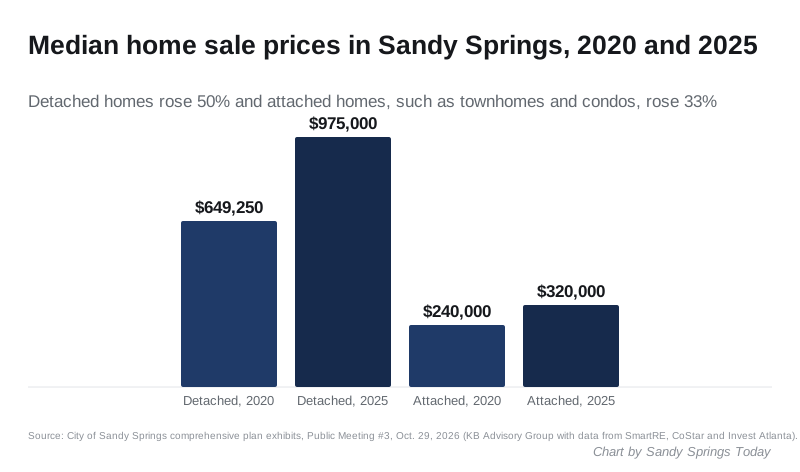
- The median detached home sold for $975,000 in 2025, up 50% from $649,250 in 2020.
- About 21% of detached homes sold in 2025 went for more than $1.5 million. Only 11% sold below the 2020 median.
- Attached homes, such as townhomes and condos, rose 33%, from $240,000 to $320,000.
- A three-person household buying a three-bedroom home needs about $144,000 a year. That is roughly 40% above the city’s median household income.
- About 53% of homes were built before 1990. The 1980s alone account for 25% of today’s homes.
Under the housing heading, the draft lists what the city is “considering”:
- policies and incentives to add more homes, and more kinds of homes, for middle-income households
- new homeownership opportunities
- a better balance between job growth and household growth
- putting the majority of new housing in “vibrant, mixed-use districts”
- adding single-family options where shops and offices already stand
- keeping major new housing developments in transition and redevelopment areas, with only “targeted infill” that fits existing neighborhoods
- working with apartment managers through the city’s Multifamily Rental Housing program to keep older, lower-cost apartments in good condition
A separate land use theme would allow smaller single-family types on the edges of established neighborhoods. The exhibits name cottage courts, conservation clusters, small-lot detached homes and duplexes. They would go mainly along main roads and next to commercial or higher-intensity land.
The same theme would keep the “scale and character” of existing single-family neighborhoods, including building height and setbacks.
What residents told the city
The exhibits summarize what the city heard at earlier meetings and pop-up events:
- a strong desire for balanced growth that protects neighborhood character
- concern about overdevelopment, building heights and the pace of apartment construction
- a need for more homeownership and single-family housing
- support for redeveloping aging commercial properties, especially in the North End
- support for improving the look of Roswell Road
This follows the city’s housing needs assessment, which the City Council heard Oct. 6.
The other parts of the draft
The draft covers five areas. Beyond housing and land use, the exhibits include:
- Places to grow. Revitalize Roswell Road with mixed-use redevelopment and safer walking, keep turning Perimeter into a walkable live-work district, and bring new investment and for-sale homes to the Powers Ferry area.
- Jobs. Sandy Springs has about 88,000 more jobs than employed residents, led by health care with 28,397 jobs. Only 8,115 residents, about 15%, both live and work in the city. The draft would expand City Springs onto neighboring land with private partners and study improvement districts for the Roswell Road corridor.
- Getting around. The city’s 2025 Safety Action Plan aims for zero deaths or serious injuries on city-owned streets by 2040. Ninety percent of surface street crashes happen on 10 streets, the exhibits say. The draft would build the Hammond Drive project, improve walking connections over and across Georgia 400 and increase sidewalk funding.
- Parks. Upgrade existing parks to a consistent standard, look for new parkland and consider dedicated funding, including “potential bond initiatives.” It would also expand public access to the Chattahoochee River.
- Public safety. Keep investing in the Police and Fire departments and their buildings.
The Oct. 29 meeting also previewed an update of the 2017 Perimeter small area plan and a master plan for Hammond Park, according to the meeting presentation.
What it means for you
- No zoning changes yet. The draft is a set of ideas. A full draft plan is due in the phase that runs to June 2027, the project timeline says.
- You can comment now. For each theme, the Engage page asks what action should look like and how the city should measure progress. The page gives no closing date.
- The next public meeting is Tuesday, Dec. 8, the presentation says. Time and place have not been posted on the project’s events page.
- Our home prices page tracks values month by month, and our permits and zoning guide explains how rezonings work.
Frequently asked questions
What is The Next Chapter in Sandy Springs?
It is the city’s update of its comprehensive plan, the long-range policy document for growth, land use, housing and transportation, done together with a new Recreation and Parks Master Plan. The city expects the City Council to adopt both in June 2027.
What does the draft comprehensive plan say about housing?
The draft framework shown Oct. 29, 2026, would focus most new housing in mixed-use districts, add policies and incentives for middle-income households, encourage homeownership and smaller single-family types such as cottage courts and duplexes on the edges of neighborhoods, and keep the scale of existing single-family neighborhoods.
How can I comment on the Sandy Springs comprehensive plan?
The Engage page at planthenextchapter.org asks residents, for each theme, what action should look like and how to measure progress. The next public meeting is Dec. 8, 2026.
Have your say