Sandy Springs keeps its 4.731-mill rate. Its notice calls that a 0.26% increase, but its own rollback form puts the rate 0.26% below. Hearings Oct. 20 and Nov. 3.
Sandy Springs will hold three public hearings on its 2026 property tax rate, starting Tuesday, Oct. 20. The city has advertised its plan as a tax increase under Georgia law.
Updated Oct. 19: the city’s own rollback calculation, published in the Oct. 20 agenda packet, puts the rollback rate at 4.7435 mills, above the 4.731-mill rate. We have corrected our earlier estimate. See the note at the end.
The city said Wednesday it intends to levy taxes 0.2635% above the rollback millage rate. The announcement is on the city’s news page.
The rate itself is not going up. The FY 2027 budget the City Council adopted June 16 is based on a rate of 4.731 mills, “which remains unchanged since the City’s inception,” the meeting minutes said.
Why a flat rate counts as an increase
Each year the Fulton County Board of Assessors revalues property. When values rise, Georgia law requires a rollback rate. That is the rate that would raise the same money as last year’s rate, on the new values, before any reassessments.
The city said its adopted budget “requires a millage rate higher than the rollback millage rate.” Any rate above the rollback counts as a tax increase. That triggers the notice and the hearings.
The city’s notice did not give the rollback rate in mills. The state form the city filed does. It is in the Oct. 20 agenda packet, attached to the first hearing.
On that form, the Georgia Department of Revenue’s PT-32.1, the rollback rate for 2026 is 4.7435 mills. That is higher than the 4.731 mills the city plans to levy. The form’s “percentage tax increase” line reads -0.26301%. A negative figure means the rate sits below the rollback rate.
The reason is on the same form. The net value added by reassessing existing property is a loss of $29.3 million, after exemptions. When reassessed values fall, the rollback rate rises above last year’s rate.
The staff memo with the form says the opposite. It describes “a tax increase of .26% following the ‘rollback’ calculation.” The city’s Oct. 7 notice said 0.2635% above the rollback rate. The figures match in size but not in direction. The packet does not explain the difference.
What it could cost you
A mill is $1 of tax for every $1,000 of assessed value. In Georgia, assessed value is 40% of the fair market value the county puts on your property.
At 4.731 mills, a home with a fair market value of $500,000 has an assessed value of $200,000. Its city tax is $946.20 a year before exemptions. Owners whose assessment rose will pay more than last year, because the same rate now applies to a higher value.
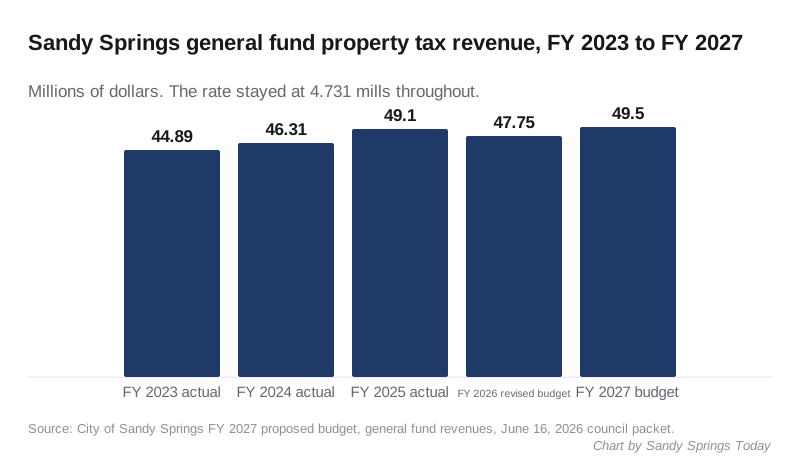
The budget papers show what the city expects to collect. The proposed FY 2027 budget projects $49.5 million in property taxes for the general fund. That is $1.75 million, or 4%, more than the FY 2026 revised budget of $47.75 million. Staff said the growth was “driven by continued growth in assessed values citywide.”
The same budget table lists what property taxes actually brought in. The general fund collected $44.89 million in FY 2023, $46.31 million in FY 2024 and $49.10 million in FY 2025, all at the same 4.731-mill rate.
The hearings
All three are at Sandy Springs City Hall, 1 Galambos Way:
- 6 p.m. Tuesday, Oct. 20
- 8:30 a.m. Tuesday, Nov. 3
- 6 p.m. Tuesday, Nov. 3, the final hearing
Nov. 3 is also Election Day. The staff memo in the Oct. 20 packet says the council will set the rate at 6 p.m. Nov. 3, after the final hearing.
The city’s rate history
Sandy Springs has never changed its rate. The city charter says it “shall not exceed 4.731 unless a higher limit is recommended by resolution of the city council and approved by the qualified voters.” The council cannot raise the rate above 4.731 mills without a public vote.
The city has run the same notice in earlier years. In July 2025 it said it would levy 0.71% above the rollback rate, in its notice that year.
What it means for you
- The city’s rate stays at 4.731 mills. Your city tax bill rises only if your assessed value went up.
- The city’s share is a small part of the bill. The city says it receives 14% of a Sandy Springs owner’s local tax dollars, on its Understanding Local Taxes page. Fulton County and Fulton County Schools set their own rates.
- You can speak at any of the three hearings. The city takes public comment online as well.
- Our property taxes guide explains the bill, the county’s rate, homestead exemptions and how to appeal a value.
Correction, Oct. 19, 2026: an earlier version of this story estimated the rollback rate at about 4.7186 mills and said the city’s rate was about 0.0124 mills above it, worth roughly $1.24 for every $100,000 of assessed value. That was our calculation from the city’s notice. The city’s own PT-32.1 form, published in the Oct. 20 agenda packet, puts the rollback rate at 4.7435 mills. We have removed the estimate.
Have your say