
Sandy Springs' city tax rate is 4.731 mills, capped by its charter. One Fulton County bill covers city, county and schools. Appeal values in 45 days.
Last checked Oct. 5, 2026. Sources: the City of Sandy Springs Understanding Local Taxes page, the Fulton County Tax Commissioner and the Fulton County Board of Assessors.
A Sandy Springs homeowner pays property tax to three bodies: the city of Sandy Springs, Fulton County and Fulton County Schools. Each sets its own rate, but you get one bill. The Fulton County Tax Commissioner takes the value and exemptions set by the county Board of Assessors, applies every body’s rate and mails the bill, the city says.
Who to call
- Your tax bill, payments, due dates: Fulton County Tax Commissioner, 404-613-6100, 141 Pryor St. SW, Atlanta; search or pay a bill
- Your property’s value, appeals, homestead exemptions: Fulton County Board of Assessors, 404-612-6440, including the North Fulton Customer Service Center, 7741 Roswell Road, Suite 210
- Questions about the city’s rate or budget: City of Sandy Springs Call Center, 770-730-5600 (24 hours)
The city’s rate
The city’s millage rate is 4.731 mills, and it has not changed since the city was founded, according to the city’s proposed FY 2027 budget message, which the City Council adopted June 16 with no tax or fee increases. The city charter says the rate “shall not exceed 4.731 unless a higher limit is recommended by resolution of the city council and approved by the qualified voters.”
The council had not taken a separate vote on the 2026 tax year rate when we checked. At the Aug. 18 council meeting, City Manager Eden Freeman said staff were waiting for final assessment documents from Fulton County and would move to set the rate shortly after, according to the meeting minutes. On Oct. 7 the city announced it would levy taxes 0.2635% above the rollback rate, which Georgia law counts as a tax increase, and set hearings for 6 p.m. Oct. 20 and 8:30 a.m. and 6 p.m. Nov. 3 at City Hall. The council sets the rate after the final hearing, at 6 p.m. Nov. 3. The city’s own state rollback form, in the Oct. 20 agenda packet, puts the rollback rate at 4.7435 mills, slightly above the 4.731-mill rate. Our story has the details. The city says it receives 14% of a Sandy Springs owner’s local tax dollars; the rest goes to Fulton County Schools and Fulton County.
The county’s rate
The Fulton County Board of Commissioners announced Sept. 23 that it intends to levy its 2026 General Fund rate 0.54% above the rollback rate. The proposed rate is 8.87 mills, against a rollback rate of 8.822 mills. The county puts the increase at about $10.56 on a home with a fair market value of $625,000, according to its notice of property tax increase.
Georgia law requires three public hearings first. Two were held Sept. 30 and the last Oct. 7, in the Government Center Assembly Hall, 141 Pryor St., Atlanta, according to the county’s announcement.
The rates in one chart
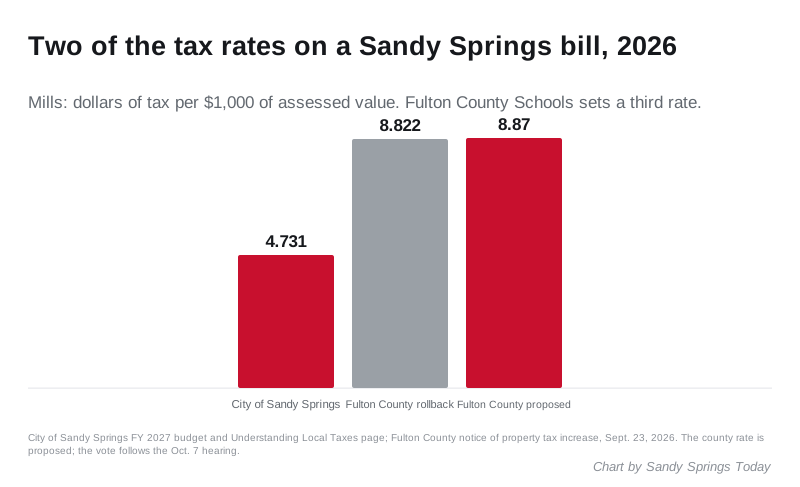
A mill is $1 of tax for every $1,000 of assessed value. In Georgia, assessed value is 40% of the fair market value the county assessors put on your property. Fulton County Schools sets its own rate, and it is the largest part of most bills.
When taxes are due
The due date is printed on the bill from the Tax Commissioner. Look up or pay a bill by parcel ID, account number or address with the Tax Commissioner’s bill search, which also takes card and e-check payments. If a mortgage company pays your taxes from escrow, check that it has the bill.
Homestead exemptions
The Georgia Department of Revenue’s homestead exemption page sets the basics:
- You must own the home and live in it as your main residence on Jan. 1 of the tax year.
- The filing deadline for that year is April 1. Georgia now also accepts applications up to the end of your 45-day window to appeal your notice of assessment.
- The state’s basic exemption takes $2,000 off the assessed value for county and school taxes.
Fulton County offers more, including exemptions for seniors, low-income homeowners and surviving spouses of public safety and military personnel killed in the line of duty. The county says exemptions renew automatically while you own and live in the home; the Fulton County low-income exemption must be renewed every two years. Details and forms are on the county’s homestead exemptions page.
How to appeal your value
The Board of Assessors mails a notice of assessment every year. You can appeal the value, not the tax amount, and you have 45 days from the date of the notice. The exact deadline is printed on it; miss it and you lose the right to appeal that year.
- File online at fultonassessor.org, in person at any of the five Board of Assessors offices, or by mail. The closest to Sandy Springs is 7741 Roswell Road, Suite 210.
- Pick one route: a hearing before the Board of Equalization, non-binding arbitration on value, or a hearing officer. Fees and other costs may apply to the last two.
- Expect months. You may get a temporary tax bill while the appeal is pending, and you must pay it or risk penalties and fees, the county says.
Frequently asked questions
What is the Sandy Springs city property tax rate? The city’s rate is 4.731 mills, unchanged since the city was founded. The city charter says it cannot go higher unless the council recommends it and voters approve.
Who sends the Sandy Springs property tax bill? The Fulton County Tax Commissioner calculates and collects the tax for the city, Fulton County and Fulton County Schools. Call 404-613-6100 or search your bill online.
How long do I have to appeal my Fulton County property assessment? You have 45 days from the date on your notice of assessment, and the deadline is printed on it. You can appeal the value of your property, not the tax amount.
When is the homestead exemption deadline in Fulton County? You must own and live in the home on Jan. 1, and the state’s deadline to file for that year is April 1. Georgia now also accepts applications up to the end of your 45-day appeal window.
Is Fulton County raising its property tax rate in 2026? Fulton County proposes keeping its rate at 8.87 mills, which is 0.54% above the 8.822-mill rollback rate, so state law counts it as a tax increase. The last hearing was held Oct. 7.
What this means for you
- One bill, from the Tax Commissioner; the due date is on it.
- The city’s share cannot rise above 4.731 mills without a public vote.
- Not homesteaded yet? File by April 1, 2027, to count for 2027.
- Want a say on the county rate? The last hearing is 10 a.m. Wednesday at 141 Pryor St.
Related: Sandy Springs home prices, moving to Sandy Springs and who to call at City Hall.
Have your say